

 United States (en)
 Germany (de)
 Austria (at)
 France (fr)



Fall 2025 Stainless Steel Cookware Collection FAQs
- Tri-ply construction: A heat-conducting aluminum core is sandwiched between two sheets of stainless steel. This provides superior heat distribution for a tri-ply construction.
- Many stainless cookware lines are made with an aluminum or copper disc attached to the bottom of the pan to aid in heat distribution. Because heat is distributed only on the bottom, this construction is less efficient and is prone to uneven heating and hot spots. TPC Stainless Cookware has tri-ply clad construction (a heat-conducting aluminum core is sandwiched between two sheets of stainless steel which extends through the entire pan including the walls);this results in even heat distribution. Our ratio of stainless steel to aluminum is exclusive to TPC. Independent testing has shown it to be the best ratio for even heat transfer throughout the entire pan.
- 18/10 stainless steel interior with a brushed finish. The brushed interior finish provides easy release and cleanup; dishwasher safe.
- 18/0 stainless steel exterior. Can use on all stovetops, including induction cooktops.
- 18 = the amount of chromium in stainless steel; 0 = the amount of nickel. The absence of nickel makes the stainless steel magnetic, a necessity for induction cooking.
- Induction cooktops, which use magnetic energy, are increasingly popular. Not all stainless cookware can be used with induction cooktops.
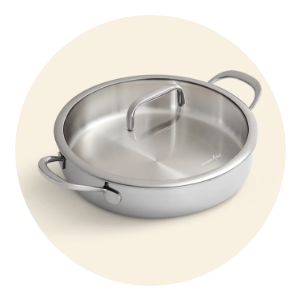
- Hollow cast stainless handles with "Y" design and hanging loop. Stay cooler during stovetop cooking; convenient hanging storage.
- Pans are oven- and broiler-safe up to 550º F (287º C). Grill safe to 600º F (315º C). Added versatility makes Stainless Cookware an excellent investment.
- Lids are heat resistant to 400º F (200º C).
- Tempered-glass lids - Cook faster by keeping heat and moisture in while still keeping an eye on your meal. Lids also fit Nonstick Stainless Collection vessels.
For tough built-up residue, add some water to the pan to cover the dirtied surface areas and place back on the stovetop. Turn the heat to medium and once water is simmering, use a spatula to scrape the residue off. Turn off the burner, allow the pan to cool and clean as normal.
We have also found that a stainless polisher / cleaner will help remove heavy built-on residues or discolorations and restore the luster the best. A cleaner, such as Bar Keeper's Friend, can be bought at most grocery stores and is inexpensive. We would not recommend using an abrasive scrub pad, as this may scratch the surface. We also find that dishwashing removes most residues.
One thing to note when cleaning is that Stainless Cookware will not look brand new all the time, unless if cleaned with a stainless polisher / cleaner. This is the nature of the material.
To maintain a clean and shiny lid, periodically clean with a cloth dampened with vinegar or lemon juice. Rinse and dry completely.
Nope! Just take it out of the box, wash it, and start using it right away
The bottoms and walls of our stainless steel cookware is 2.5 mm thick.
Preheating is usually recommended for stainless-steel cookware, but it depends on your recipe. Follow the instructions and recommended preheating times in your recipe.
Ensure that the pan is positioned centrally over the burner, and select a burner that matches the diameter of the cookware base. Gas flames don’t hit the center of the pan, so preheating will let the bottom of the pan heat evenly.
The stainless steel pans are freezer-safe, but always fully thaw both the pan and food in the refrigerator before cooking.
Yes, each size shares the same size lid.